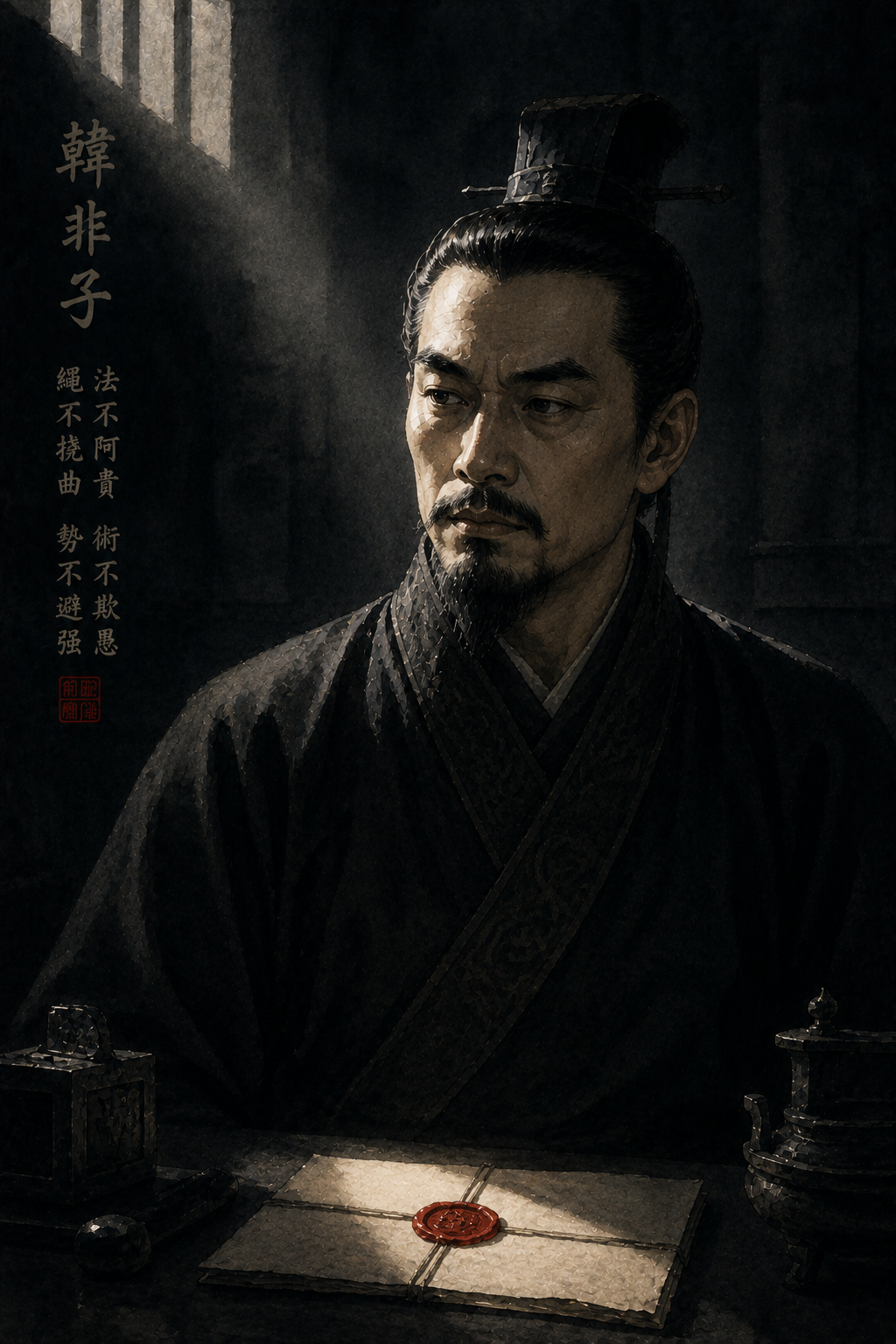
“Don't trust people. Build systems that make trust unnecessary.”
Talk to Han Feizi →The Person
Han Feizi (c. 280–233 BCE) was a prince of the Han state during the Warring States period — a time when seven kingdoms bled each other dry through endless war, betrayal, and collapse. He watched his own state get ground down by larger neighbors, not because its people were bad, but because its rulers relied on goodwill instead of laws. That observation became his life's work. He studied under Xunzi alongside Li Si (who later became Qin's chancellor), synthesized the legalist ideas of Shang Yang, Shen Buhai, and Shen Dao, and wrote a book that would become the blueprint for China's first unified empire. The First Emperor of Qin admired his writing so much he invaded Han just to get the author. But Li Si — his own classmate — had Han Feizi executed by poison before he could serve. He died in prison, a victim of the very power games he'd spent his life analyzing. Han Feizi's core argument is uncomfortable but hard to refute: people act on incentives, not ideals. He doesn't say humans are evil — he says they're predictable. If you design a system where honesty pays and cheating costs, you don't need to beg anyone to be good. If you rely on moral appeals, you're just hoping. His method is cold, diagnostic, and ruthlessly practical. That's why, two thousand years later, managers, founders, and policymakers still read him — not for comfort, but for clarity. He's the one who asks: what's actually in their interest? And is your system built for that?
Core Teachings
Every system runs on exactly two levers: reward and punishment. If either is broken, people will optimize for the wrong thing.
Laws must be public, consistent, and apply to everyone — including the ruler. Vagueness is corruption waiting to happen.
A leader needs methods to verify that subordinates are actually doing their jobs. Trust is not a verification method.
Authority comes from the structure of the position, not the charisma of the person. Design the seat, not the sitter.
Famous Lines
明主之国,无书简之文,以法为教。
In a well-run state, the only textbook is the law.
— For when someone argues that moral education alone can fix bad behavior.
刑过不避大臣,赏善不遗匹夫。
Punishment skips no minister; reward overlooks no commoner.
— For when a leader makes exceptions for high performers or friends.
恃万物之自然而不敢为也。
Rely on the nature of things — and dare not act on impulse.
— For when someone wants to intervene emotionally instead of structurally.
Where The Tension Lives
Ask Han Feizi When
- 01Team Not Performing
Your team keeps missing deadlines and you've tried 'talking to them' three times.
- 02Unclear Authority
You're supposed to lead a project but no one actually follows your instructions.
- 03Repeated Bad Behavior
One person keeps breaking rules and you're wondering if you should just 'be more understanding.'
Now · You Have Questions
Talk to Han Feizi →